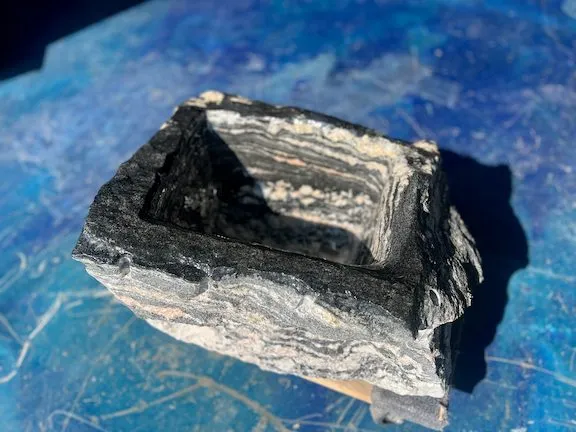
Xf/Ysp · Migmatite

Migmatite Xf/Ysp #004

Layered like an Oreo, and 1.8 billion years deep.

$4,700

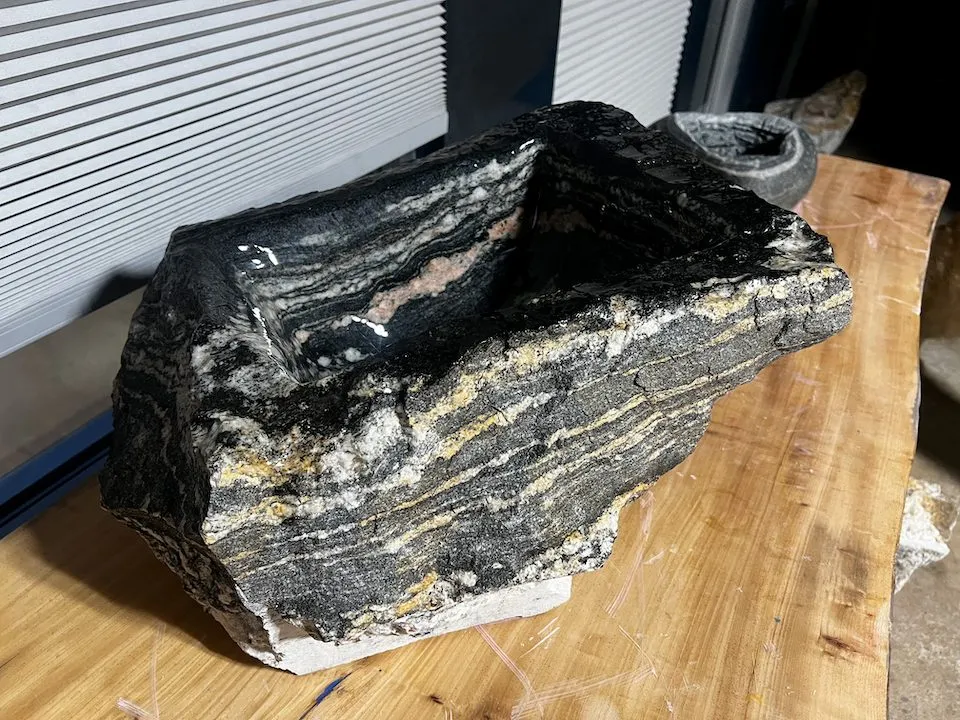
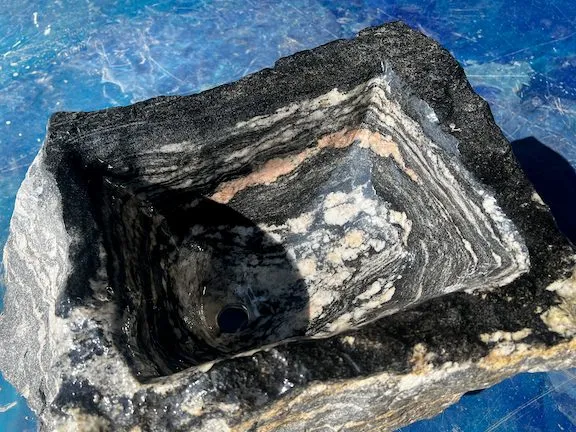
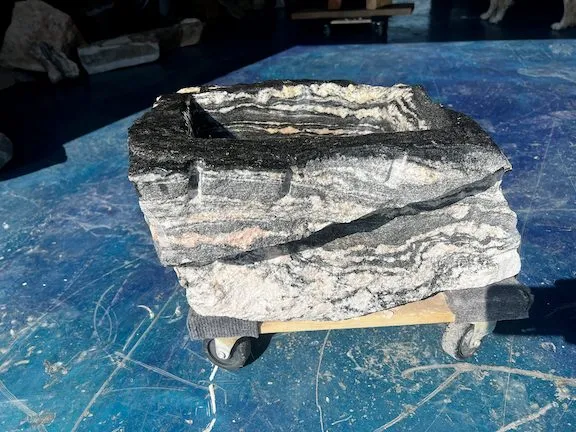
Outspoken, deeply carved, a bold presence visually and physically, the wild 'oreo cookie' layers of this sink invite you to reach your hands in to touch the oldest version of Colorado some 1.8 billion years ago

Exposed by a huge landslide triggered by Clear Creek's relentless cutting, the original volcanic stone melted and reflowed and recrystalized 1.8B years ago, then was punctured again 400 million years later when the pink Silver Plume granite intruded

Dimensions
24 × 14 × 18 in
Weight
133.5 lb
Age
1,800 & 1,422 Ma
Formation
Quaternary landslide / roadcut
Sourced nearSilver Plume, COClear Creek canyon, off I-70

Spellbindingly unfair the layers in this stone are; contrasting colors, flowing lines & inviting visual textures

I knew they were good when I picked up the parent stone with my crane, and even more deliciously confirmed when I split it into 3 vessel sink candidates

But it wasn't until the third tranche of diamond sawcutting that the pink Silver Plume granite emerged. I knew in an instant this stone was special

The grey & white layers are 1.8B years old, a felsic gniess of volcanic origin as the first island arcs were scraped onto the Wyoming Province. Then gently(?) melted in the echos of the second wave of islands. Some 400M years later the Silver Plume granite intruded, melting, reflowing, & recrystalizing into the 'Injection Gniess (Migmatite)' that we see today

Fast-forward through the rising and eroding of the Colorado Rockies to 40,000-ish years ago when the Pinedale glaciation exposed some delicate westwardly facing cliff (~14 million sunsets!!) where this rock lived, only finally to be thrown down in a violent landslide precipitated by the relentlessly grinding chewing of Clear Creek

If I-70 had been around 3 or 4 thousand years ago, you maybe could have waved at it still hanging high on the mountain as you drove by...
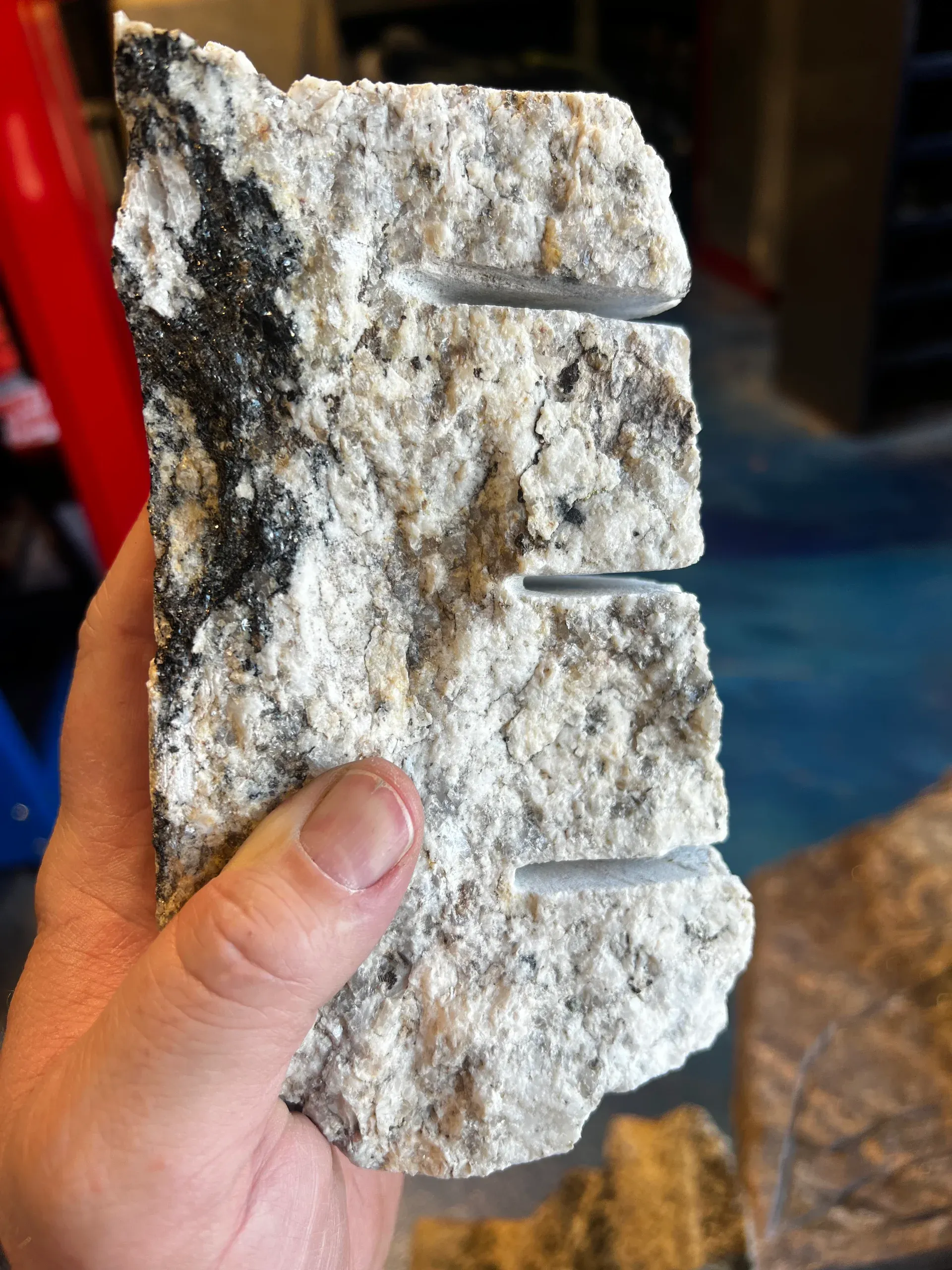
Migmatite #004 partway through carving
From the shop

Stone & Carving notes

The carving varied wildly as I dug the bowl out deeper and deeper. The upper dark layers required a slow, scratching, precise patience characteristic of working through many parallel planes of biotite, but would chaotically speed up as the blades dipped into a pocket of more easily cut lighter colored stone.

The lowest levels of the bowl were more buttery and flowing to cut, speckled with smaller brittle sections which could almost be 'chipped' away on the largest diamond saw. However that also meant I had to be much more careful to not blow out the bottom of the sink.

The chiseling was equally variadic and troublesome. The upper layers were prone to the brittle 'snap' of a stone with many parallel sheets and could be controlled with careful 'porcupining' except that they would sometimes explode and torque into the softer layers and pockets unpredictably.

Then as I moved deeper in the bowl, the chiseling gradually softened into the more responsive and forgiving and expressive strikes of a more uniformly distributed fracture plane matrix; although that also meant I was closer to blowing out the bottom again...

I ended up using a conservative approach where I removed 4/5ths of the volume on a first pass, then went back for a second pass with the smaller diamond saw and detail chisel, before switching out to two grinding passes of rough & final shape.

Contrast this with my technique on a more consistent and uniform stone like a granodiorite or quartz monzonite: I can usually remove the full 'scoop' of volume of the bowl on the first pass with just saw & chisel, and often times skip right to final shape grinding and polishing.

All told I probably spent 3-4x more time, and consumed 2x the diamond saw blades cutting this one into shape than a typical comparably sized stone. But it was such a fun rock to work on that I'm kind of glad I got to spend the extra time with it

Felsic gneiss and Silver Plume migmatite
Geology

Felsic Gneiss, Silver Plume Migmatite

The upper half is darkened by repeated layers of biotite rich gneiss, punctuated by several thin white biotite poor layers and one noteworthy band of pink Silver Plume granite.

A striking contrast is offered by the lower 1/3rd of the stone, where quartz and plagioclase phenocrysts scatter amongst the white of what is probably calc-silicate gneiss

Reading through the USGS description of this geologic unit, it's rather remarkable that pretty much all the expressions offered in their description can be found somewhere on this sink even just to the naked eye.

I was particularly struck by their comparison of the tan expressions of this stone being similar to nearby Ygd emplacements.

I had several similar Xgd stones in my shop at the time, sourced about 40 miles north of this one, and the resemblance is fascinating!

The Xgd is a bit older than Ygd, but there is a good case to be made that it was probably the same batholith just melting into the crust at two different times in nearby spots.

I've also worked some stones of the Boulder Creek Granite with similar character, so I have a new theory about what Xf looks like when melted by the proterozoic intrusions (Routt & Berthoud). There's some Xf near Lone Eagle Peak which I'm now incentivized to go hike to and hunt for siblings of this stone!

Inquire · reserve · commission

Custom sinks carved from the Rockies.

Tell me about your space and which stone caught your eye. Come see it in person at the shop, or let's dream up something unique to match your vision, and I'll go find it in the wild.

Stone Wood & Steel12550 W Colfax Ave #105, Lakewood, CO 80215720 · 357 · 0089[email protected]
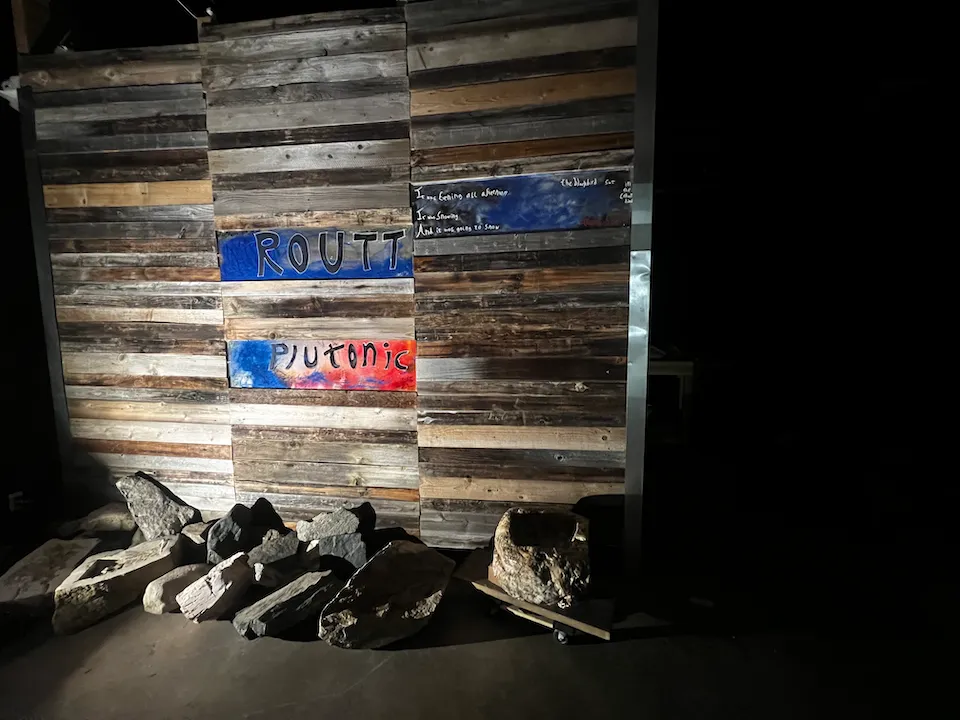
Painted Routt Plutonic sign on a reclaimed-wood wall at the shop, with raw stones piled below