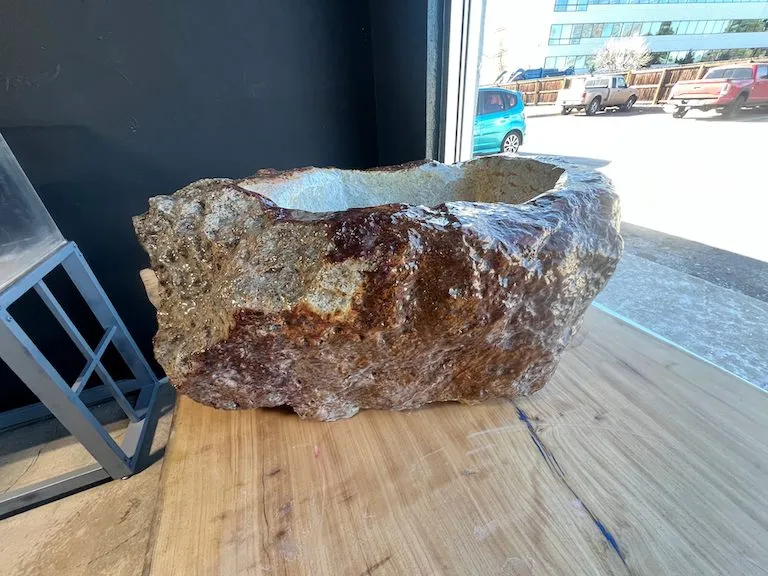
← Available sinksRare series · 1 of ~6
Tqm · Quartz monzonite

Iron Fen (Tqm) #03

Iron-rich spring water painted it red.

$27,000

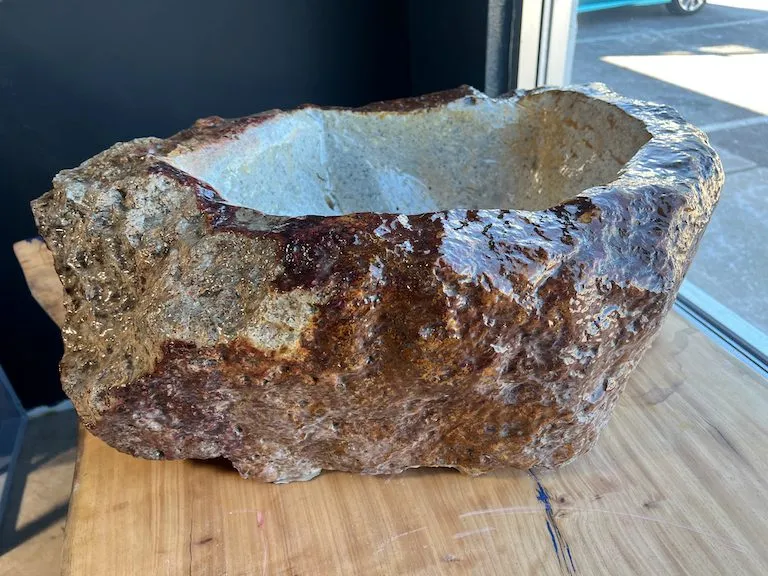
The base stone is quartz monzonite, some of the youngest granite in Colorado. Over thousands of years, warm water rich in dissolved iron coated it a deep red. This happens in fewer than a dozen places in the world. I sealed the red outer layer in epoxy to protect it.

Only about 7–9 stones like this are within reach, and I broke the first two while learning to cut them. There will be five or six more in this series, and each one will cost more than the last.

Dimensions
26 × 20 × 10 in
Weight
212 lb
Age
38.8 ± 0.5 Ma
Formation
Iron bath / post-Pinedale
Sourced nearMontezuma, COBelow a protected iron fen

The western half of Colorado is chock full of idyllic wilderness spots to plop down and repose next to a lovely babbling brook.

But there's this one particular brook who babbles (slightly warm) water with wild concentrations of dissolved iron ions, even still to this day

This stone originally snapped loose a bit uphill of the modern day fen, eventually sliding to rest well downstream of the protected area, so it's hard to say if the thick outer red iron accumlation took more or less than 40,000 years to form. I encased it in epoxy to preserve it regardless

The base stone is a tertiary quartz monzonite, some of the youngest granite in Colorado; and the land owner I sourced it from is definitely one of the most eccentric ones I've ever met. The iron deposition process which painted the exterior red happens in less than a dozen other places in the world. There are probably only 7-9 more stones like this one that I can get my diamond saws on, and I shattered the first two I worked with, till I figured out the technique/touch required

The price reflects the rarity. There will only ever be 5 or 6 more like this one; so assuming anyone buys the first, I'll likely (p*2^n) the price for the remainder of the series
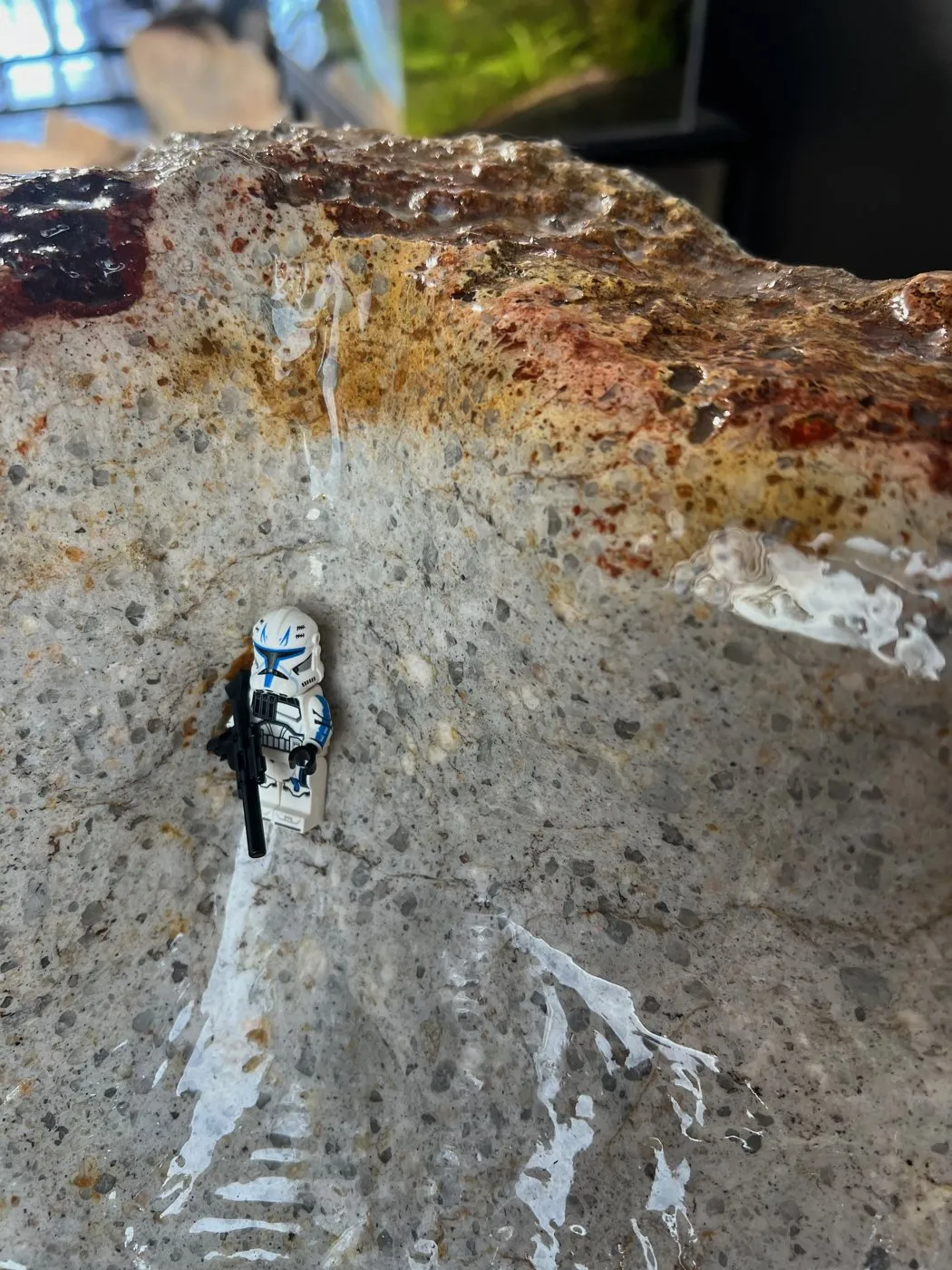
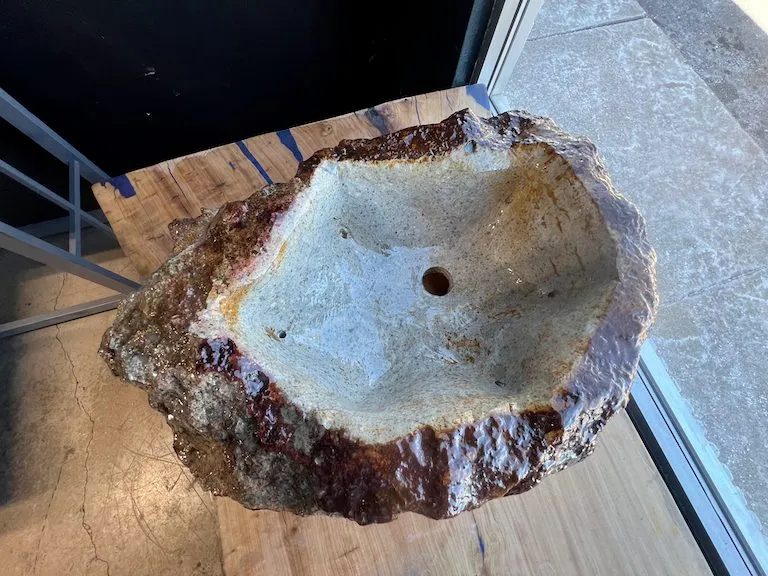
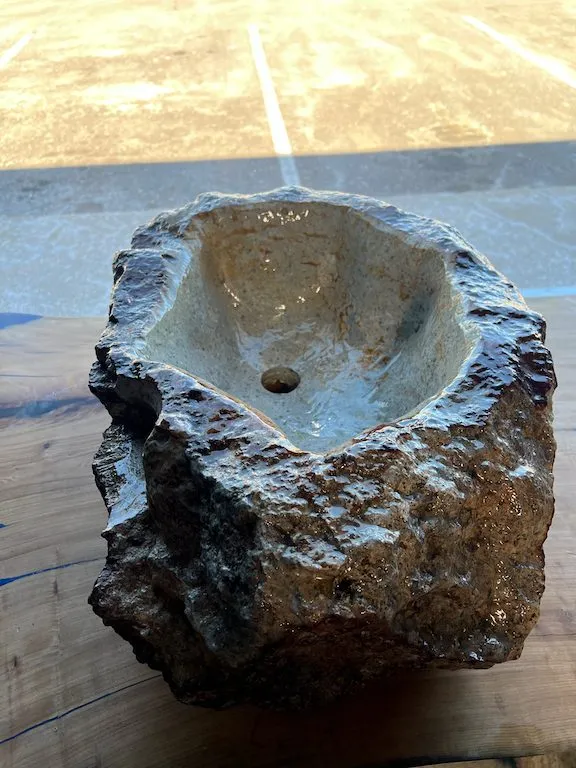
Inside the carved bowl of Iron Fen #03: speckled grey quartz monzonite below the iron-stained red rim, with a toy figure for scale
From the shop

Stone & Carving notes

It's kind of hard to describe, purely subjective and not objective, and quite possibly just simply untrue, but; I do think that sitting in an iron rich warm water bath for tens of thousands of years leeched out & changed the entire inside chemistry and structure of this stone as much as it painted the outside red

It's a Quartz Monzonite, some of the youngest 'granite' found in Colorado.

Being so young it usually can hold wild jagged shapes and near knife-like edges.

Typically it fights me and I have to work a little harder and more carefully to cut it than a granite or granodiorite of similar appearance makes me.

But this one seemed to yeild much more quickly to sawing, and chiseling was more forgiving with phenocrysts falling apart in an almost 'chalky' crumbling instead of their usual gravel-y snapping.

I had originally planned on making the walls much thinner, but given the large overall size of this sink, and not willing to risk wasting such a rare exterior, I played it more conservative and left them quite thick.

Proportionally that probably works out to a better choice anyway, just given the sheer size of the final sink.

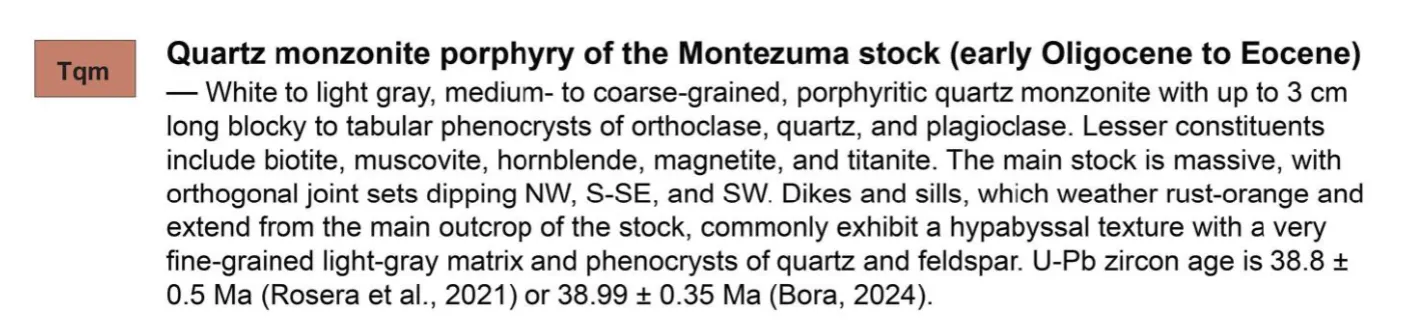
USGS map description of Tqm, quartz monzonite porphyry of the Montezuma stock (early Oligocene to Eocene): white to light gray, medium- to coarse-grained porphyritic quartz monzonite; U-Pb zircon age 38.8 ± 0.5 Ma or 38.99 ± 0.35 Ma
Geology

Quartz Monzonite Porphyry of the Montezuma Stock, Tqm

While the San Juans were bursting into Colorado and throwing huge quantities of ash over the eastern plains some 30 million years ago, the batholith near Montezuma Colorado was content to chill beneath the surface and eventually cool into this intrusive expression of magma.

It took me over 6 months, and three follow up hikes studying the rocks uphill from this one to truly get comfortable classifying it as the Tqm geologic unit found in this region of the USGS maps

And I do like the interior of this sink quite a bit, but the exterior coating really steals the show.

The colors are wonderful, and I love comparing this shade of red to stones who derived their pinkish reds from radioactive decay instead; but the smoothness of texture is what really tells the story for me. Several exterior sections had their red exteriors snapped off in the recent past (whether from rockfall thousands of years ago, or human activity 100 hundred years ago, who can tell?) and they provide the contrast needed.

Comparing the two, you can see the swelling accumulation of rounder and softer layers of red minerals, muting and subduing the rougher base texture evident on the 'clean' sections of the exterior.

I felt strongly about encasing all of this sink in epoxy to preserve the uniqueness and rarity of a surface derived from this geologic process, but if you really wanted it, I could resurface the inner bowl back to diamond ground / light sealant. The speckled phenocrysts stand out more visually with epoxy, but the finger-feel of the natural stone is kind of cool too.

Inquire · reserve · commission

Custom sinks carved from the Rockies.

Tell me about your space and which stone caught your eye. Come see it in person at the shop, or let's dream up something unique to match your vision, and I'll go find it in the wild.

Stone Wood & Steel12550 W Colfax Ave #105, Lakewood, CO 80215720 · 357 · 0089[email protected]
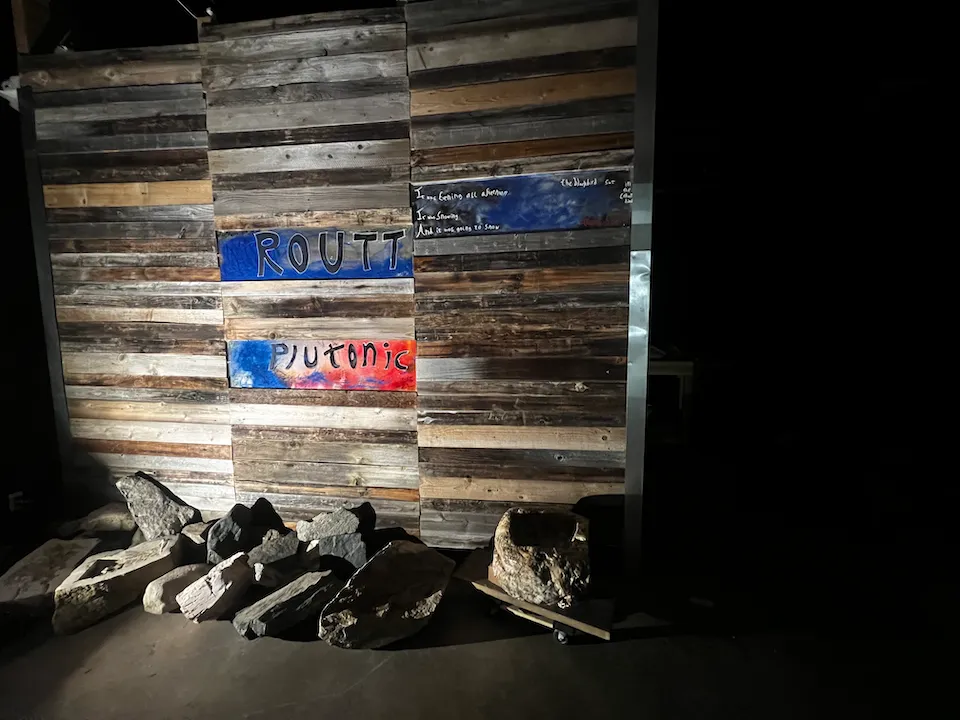
Painted Routt Plutonic sign on a reclaimed-wood wall at the shop, with raw stones piled below