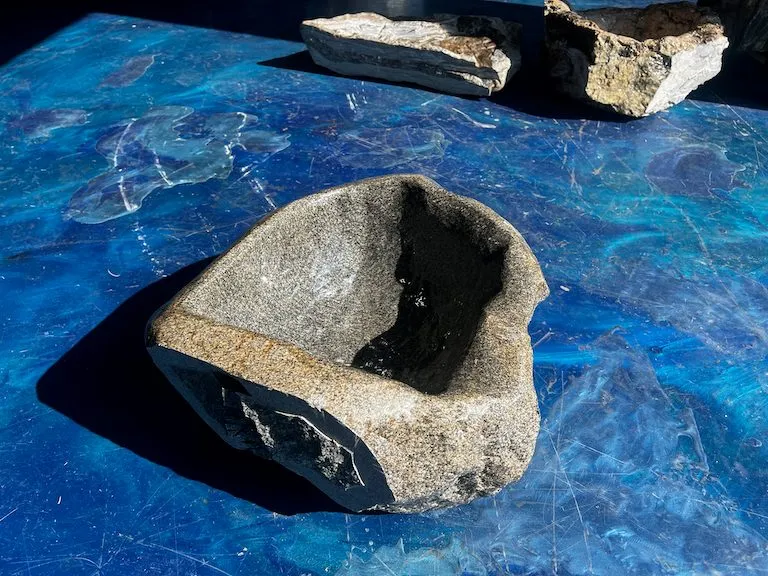
YgLP · Glacial granite

Glacial Granite YgLP #001

Glaciers scoured the outside with violence, I scratched out the interior with reverence

$2,300

Emerging from a 20,000 year nap in a rock pile nestled in a pine forest, this stone recently took an exciting ride grinding it's way down 3,000 vertical feet encased in glacial ice.

The visual textures are subtle and largely uniform, resulting from an even aphantic matrix strong enough to survive the trip down the mountain. A perfect medium to instead draw attention to the flowing curvatures of stone.

Dimensions
19 × 17 × 10 in
Weight
145 lb
Age
1,420 ± 25 Ma
Formation
Pinedale inner moraine
Sourced nearTabernash, COFraser Valley, west of the Indian Peaks

I have this very wonderful and very young snowy childhood memory of sledding and sliding down some north-facing mountainside near a cabin in Steamboat Colorado all day while my parents were out skiing. I had to have been quite young because my little brother isn't in this memory, and yet I think I was unsupervised, which would seem wild for a (probably) 4 or 5 year old kid; but... it was the 1980's

I couldn't have known then; but about 80 miles southeast of me there was this field of super cool rocks that had similarly slid & grinded their way down a north facing icy glacier 40,000 years before I was born; then just fell into a pile when the ice melted.

The outside of this stone was cut by the low rumbling patience of slow moving ice during the Pinedale glaciation, probably within or close to eyesight of what we now name 'Lone Eagle' peak. Then it just sat there with its' siblings while the glacier melted, and the trees and forest sprang up around it. An otherwise unremarkable hill in a quiet forest, but if you know what you're looking for...

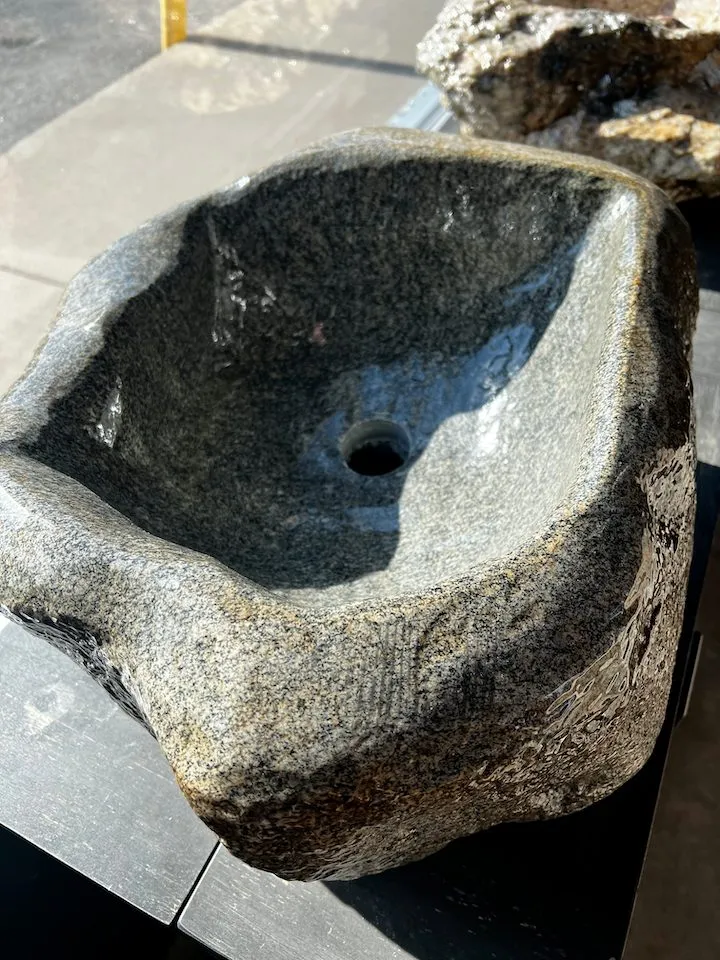
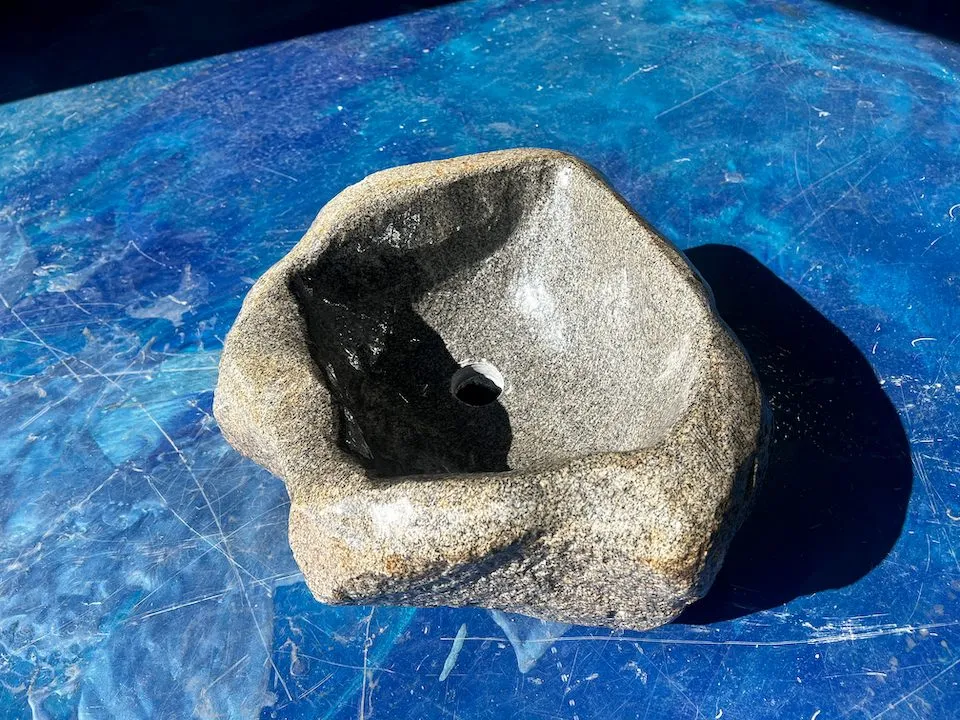
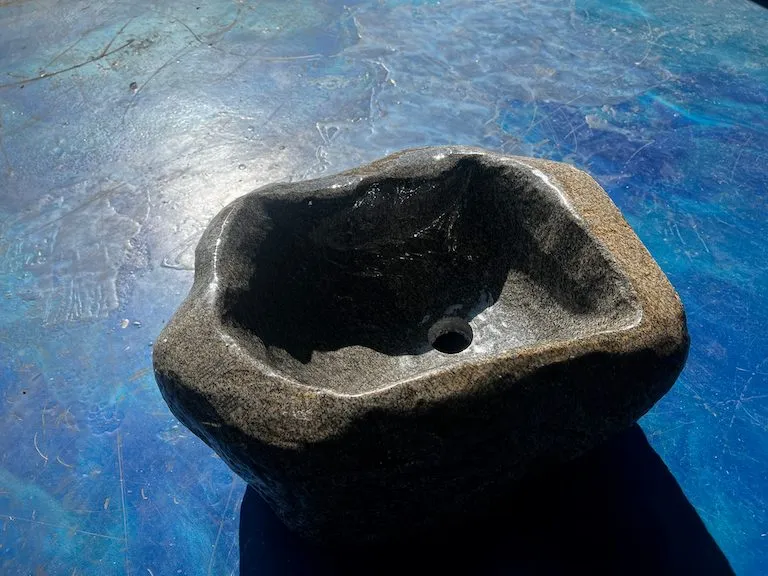
I tried my best to honor and echo the tactile subliminality of shape which the glacier kissed the exterior with, when I scooped out the inner surface. I honestly don't know if I succeeded or failed, but I do almost always stop to run my hands over this one every time I walk by it, just to check.

Some of the inner contours were cut as a deliberate form of meditation/rememberance of poignant rock-climbs/hikes I've done in the Indian Peaks east of where this stone was born.
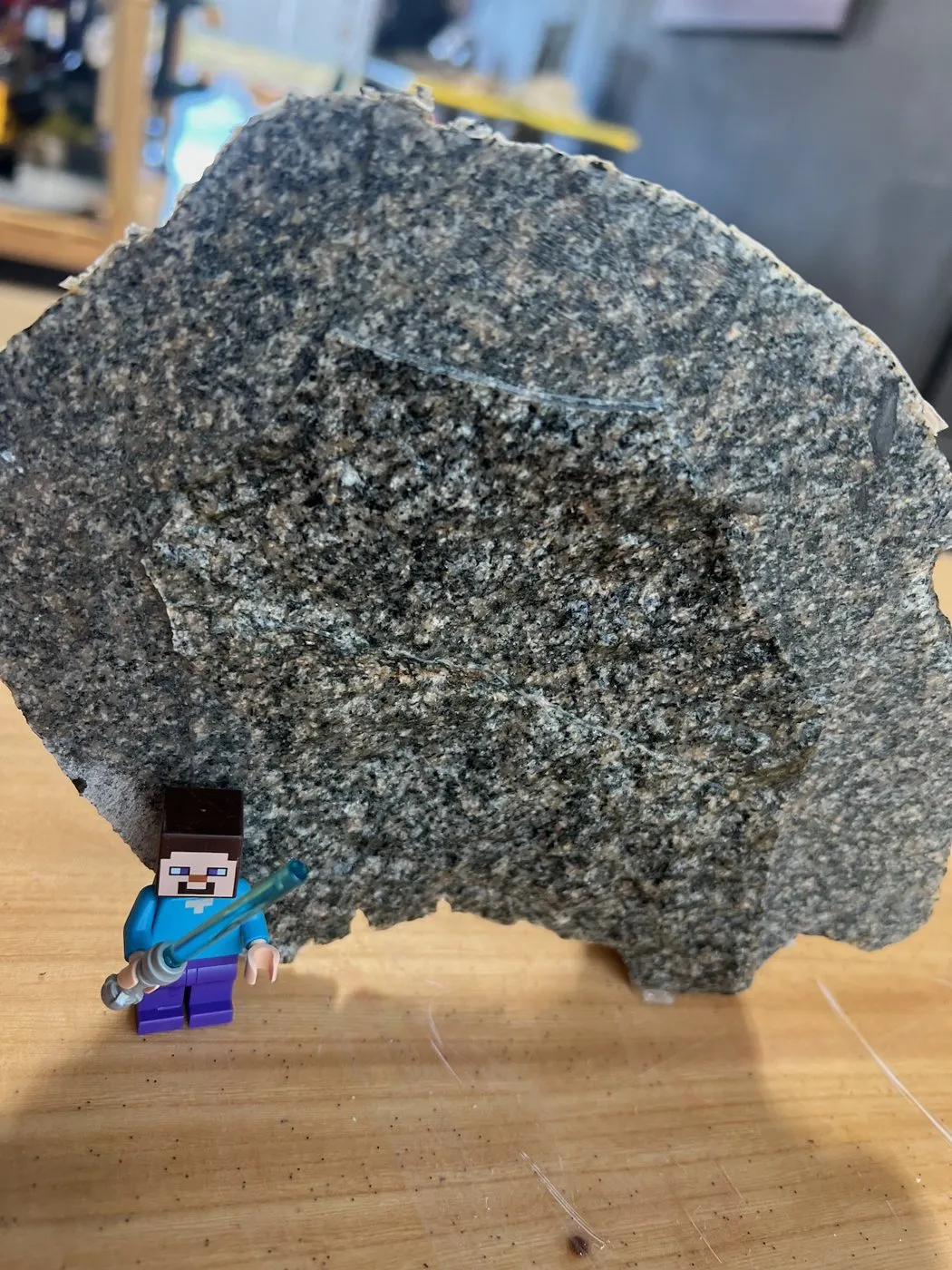
Saw-cut face of Glacial Granite #001 showing its fine salt-and-pepper grain, with a toy figure for scale
From the shop

Stone & Carving notes

Glacially carved surfaces are endlessly interesting to me, especially when you try to imagine the 'techniques' and forces and time it took to carve those shapes and curves the way they ended up.

By that measure the interior is straightforward and kind of boring: Diamond saw into chunks, hammer those out, chisel and grind down to a final surface profile, all done in a couple of days.

Contrast that with the several hundred or thousand year journey carried down a mountain on a glacier that carved the exterior.

Every large curve and contour likely the result of a split second of wild violence as this stone and another were thrown into each other as rockfall, or the result of twisting beneath a sharp corner of some massive boulder sliding by for a few years.

Each definitive 'stroke' which shaped it then punctuated by years or decades of quietly hanging out encased in ice, high in a mountain valley. We can only guess what natural forces shaped each surface, but that's exactly what I like to imagine when I look at it, and feel in my fingertips when I touch the stone.

I tried out a number of finishes for the interior and the lip: hand-chiseled, polished, diamond ground with light sealant, rough hewn with epoxy, etc...

I eventually settled on epoxy, as the colors and textures just looked really good that way.

The price does include customizations, so I will re-finish it if you prefer. Polished brought out the oranges & pinks, diamond ground with light sealant works out to a more muted lighter grey, while hand-chiseled doesn't really work here.

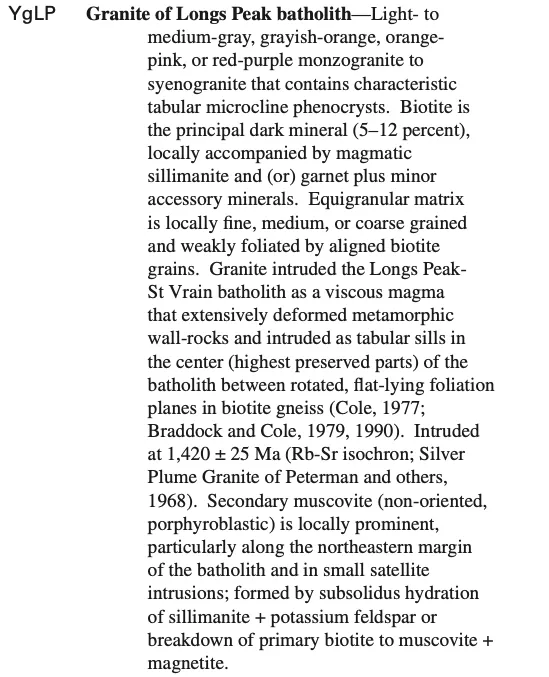
USGS map description of YgLP, Granite of Longs Peak batholith: light- to medium-gray, grayish-orange, orange-pink or red-purple monzogranite to syenogranite with tabular microcline phenocrysts; intruded at 1,420 ± 25 Ma
Geology

Granite of Longs Peak Batholith, YgLP

From my reading of some older maps and texts, the Longs Peak granite was originally classified as Silver Plume granite, owing to the fact that they are most certainly from the same large pluton of magma pushing up across the front range during the Berthoud plutonic suite; and they were first studied near Silver Plume Colorado where mining activity was fierce.

But I kind of do like the idea of renaming it 'Longs Peak' granite, as well as the related 'Mt Evans' granite because it lets one stand on top of either of those 14,000 ft peaks and looking out across the front range, and imagining how vast and interconnected and wild this large pluton of magma was 1.4B years ago as it melted up into the crust of ancient Colorado. A crust miles deep which has now been eroded away.

Looking closely at this particular stone, we find a largely homogenous expression of geochemistry, with most square centimeters being more or less indiscernible from each other.

That's not particularly surprising though, given that this stone formed by surviving the guantlet of grinding down a glacier. Had there been any weaker seams of different material, or faults or odd fracture planes, it simply would not have survived intact for us to see today.

The general profile of minerals for granite in this unit means that it's not particularly at risk for pitting or spalling when exposure to water produces clays, so it could be left unsealed even though it will be frequently exposed to water.

The decision to use epoxy was largely because I liked the color and the better visibility of the small biotite and other phenocrysts suspended in the aphantic matrix. I will say though that I prefered the tactile feel when running my fingertips over the stone more when it was just diamond ground.

Inquire · reserve · commission

Custom sinks carved from the Rockies.

Tell me about your space and which stone caught your eye. Come see it in person at the shop, or let's dream up something unique to match your vision, and I'll go find it in the wild.

Stone Wood & Steel12550 W Colfax Ave #105, Lakewood, CO 80215720 · 357 · 0089[email protected]
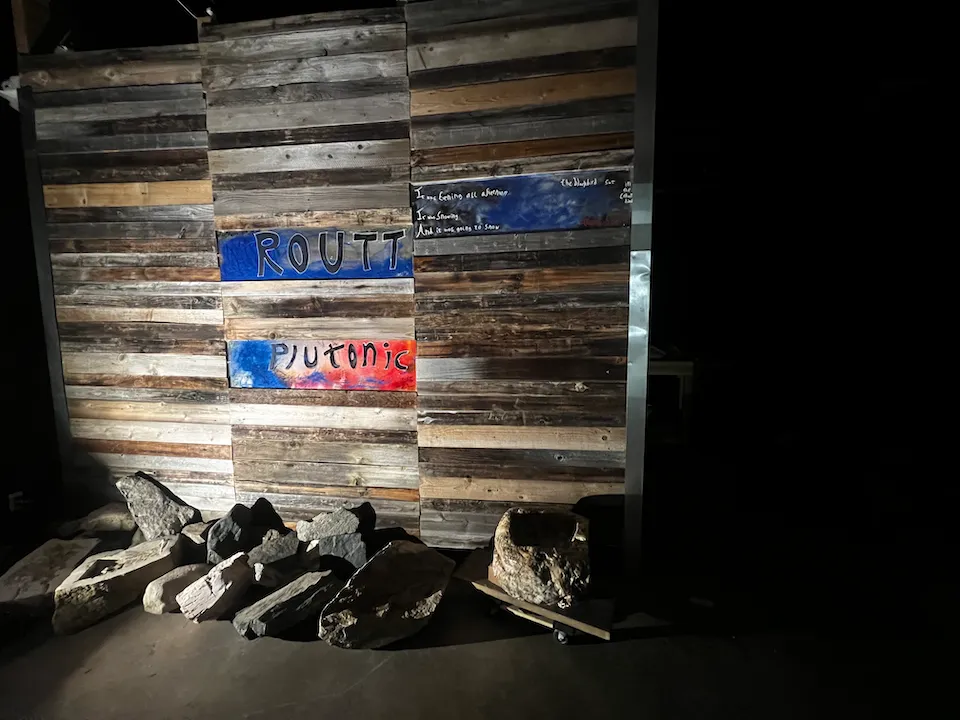
Painted Routt Plutonic sign on a reclaimed-wood wall at the shop, with raw stones piled below